

Australian Patent Drawing Requirements Made Easy: Rules, Format, and Best Practices
Not all drawings make the cut. In Australia, even a minor formatting error can stall your patent application. That’s why understanding the Australian patent drawing requirements is more than a checkbox task. It is a compliance decision that can shape how fast your patent moves.
Australia is part of the PCT system, so PCT-compliant drawings are accepted during the international phase. But once you enter the national phase, IP Australia applies its own formatting rules. These aren’t always obvious. A figure label too close to the margin, a font size that’s slightly off, or a shaded line can all trigger a formalities objection.
To stay compliant, you need to follow two key documents. The Patents (Formalities Requirements for Patent Documents) Determination 2022 sets the hard rules. The Patent Manual of Practice and Procedure explains how IP Australia interprets them.
This guide breaks everything down section by section. So whether you’re filing directly in Australia or entering via the PCT, you’ll know exactly what your patent drawings must include and what they must avoid.

Drawing Requirements and Acceptable Types
Patent drawings are not always mandatory in Australia, but when they are included, they must comply with precise formatting and content rules. This section outlines when drawings are required, what types are acceptable, and how they are treated under Australian regulations.
1. Are drawings always required in a patent application?
No. Drawings are only required if they are essential to understand the invention. However, the patent office urges to use drawing wherever possible to help describe your invention.
2. Can you include drawings even if they’re not essential?
Yes. Applicants may voluntarily include drawings if they help illustrate the invention, even when not strictly necessary for understanding it.
3. Can the patent office request drawings after filing?
Yes. If the original submission lacks drawings that are later deemed necessary for clarity or examination, the Commissioner may request the applicant to provide them.
4. Are flow charts and block diagrams considered drawings in Australia?
Australian rules do not explicitly mention flowcharts or block diagrams as drawings under Australian law. While the PCT recognizes them as such, Australia’s rules do not clarify this directly.
Therefore, unless used to illustrate a structural or functional feature of the invention clearly, their acceptance would be at the examiner’s discretion. It’s best to treat them cautiously and format them to comply with general drawing standards if included.
5. Is there a minimum time limit set by IP Australia to provide drawings if requested?
No fixed minimum time limit is specified in the Patents Manual or the Formalities Determination for when an examiner requests drawings after initial filing. The response deadline would depend on the examination report’s instructions or the particular formality notice issued.
6. Can previously submitted drawings be reused in the national phase?
Yes. If the originally filed drawings comply with IP Australia’s formal requirements, they can be reused in the national phase. However, if they are poor quality or not compliant, IP Australia may request replacements.

7. Can an entire missing sheet of drawings be corrected after filing?
Generally, no. An entire sheet of drawings cannot be added post-filing unless the application satisfies the incorporation by reference conditions.
8. Are rectifications of obvious mistakes in drawings treated as amendments?
No. Obvious mistakes (such as typos in reference numbers or missing labels) can be corrected without being treated as amendments, provided they do not introduce new subject matter or alter the substance of the invention.
9. When can drawings be amended during the application process?
Applicants may amend drawings during examination, typically in response to an adverse report. However, all changes must remain fully supported by the originally filed specification and must not introduce new matter.
10. What should an examiner do if referenced drawings are missing from the application file?
If a drawing referred to in the specification or claims is missing, the examiner will issue an adverse report requesting correction. This may include submitting the missing drawing or clarifying its absence.

Sheet Size, Usable Area, and Margin Requirements for Australian Patent Drawings
Patent drawings submitted to IP Australia must adhere to the formatting requirements outlined in the Patents Regulations 1991 and the Patent Manual of Practice and Procedure. These rules are mandatory for ensuring reproducibility and compliance during examination.
11. What sheet size is required for Australian patent drawings?
Sheets containing drawings, graphics, or photographs must be A4 size (210 mm × 297 mm).
12. What is the maximum usable surface area for each sheet?
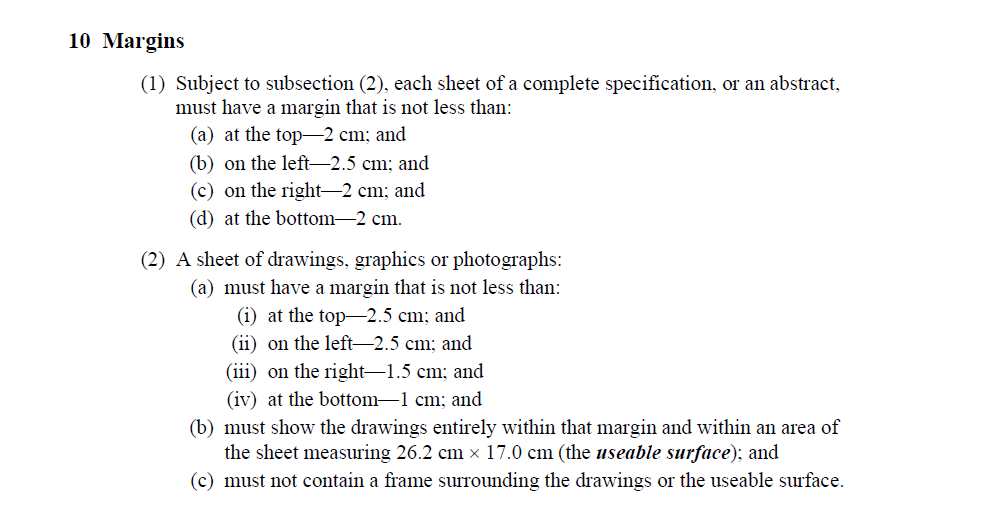
The usable surface must not exceed 26.2 cm × 17.0 cm. Drawings must be entirely contained within this area.
13. Are frames allowed around the usable surface?
No. Sheets must not contain any frame surrounding the drawings or the usable surface.
14. What are the margin requirements for drawing sheets?
Sheets with drawings, graphics, or photographs must have the following minimum margins:
- Top: 2.5 cm
- Left: 2.5 cm
- Right: 1.5 cm
- Bottom: 1.0 cm
Placement and Format Rules for Drawings in Australian Patent Applications
Correct placement, numbering, and formatting of drawings are essential to ensure your Australian patent application meets formal filing requirements. Unlike textual elements such as the description or claims, drawings must be submitted on separate sheets, follow specific numbering conventions, and maintain uniformity across all figures and views.
This section outlines IP Australia’s current standards for presenting drawings, so you can confidently prepare compliant drawings for both original filings and amendments.

15. Where must drawings be included in an Australian patent application?
Drawings, graphics, and photographs must be provided on separate sheets and are not allowed within the body of the description, claims, or abstract.
16. How must drawing sheets be numbered?
Drawing sheets must be numbered separately from the rest of the specification. Each sheet is numbered using two Arabic numerals separated by a forward slash (e.g., 2/10), where:
- The first number = sheet’s position
- The second number = total number of drawing sheets
17. What format must be used for drawing sheet numbers?
The format required is: X/Y, where:
- X is the current sheet number
- Y is the total number of drawing sheets submitted
For example, if you submit five drawing sheets, the third one should be marked as 3/5.
18. How must figures within the drawings be numbered?
Each figure should be labeled clearly and numbered consecutively using Arabic numerals. Moreover, each expanded view must be treated as a separate figure and included in the overall figure numbering.
19. How must additional drawing sheets be numbered if added later?
If you add new drawing sheets after filing, you must renumber all sheets so the full set follows a consistent X/Y format.
For example, if you originally had 5 sheets and added 1 more, all sheets should be renumbered 1/6 through 6/6.
Also:
- New sheets must be clearly distinguishable
- Figure numbers and references in the description must be updated for consistency
Use of Text in Patent Drawings – What Is Permitted and How It Must Be Placed
Text in Australian patent drawings is strictly controlled to maintain clarity and ensure international harmonization. This section outlines what types of words are allowed in drawings and how they must be presented.
20. Shall text be allowed in patent drawings?
No, except in limited cases. According to australian rules, a drawing, graphic or photograph must not include text, other than a word or words indispensable to the understanding of the invention.
21. How shall any indispensable words be placed within the drawings?
The Australian Manual notes that where text is permitted, it must not obscure drawing elements or interfere with interpretability.
This implies that any indispensable text should be positioned with enough spacing and clarity that translated substitutes could be added without overlapping or distorting the original lines.
Special Drawing Requirements for Australian Patent Applications
This section outlines the Australian equivalents of the PCT’s detailed requirements concerning line quality, proportions, reference signs, and figure clarity.
22. How shall lines and strokes in drawings be executed in Australia?
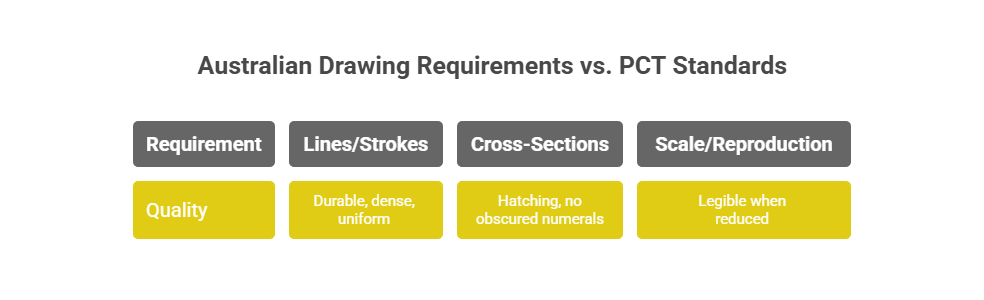
Drawings must use durable, dense, uniformly thick, and well-defined lines and strokes. The use of drafting instruments is expected.
23. How shall cross-sections be indicated in drawings?
Cross-sections must be rendered using hatching (oblique lines), and the style should not obscure reference numerals.
24. What graphical standard shall drawings meet for scale and reproduction?
Drawings must be suitable for reproduction and maintain legibility even when reduced by two-thirds in size, to ensure photo-reproducibility.
25. How shall scale be shown when used in a drawing?
Where scale is included, it must be graphically depicted and not rely solely on textual indicators. This is in line with global best practices and international harmonization.
26. How shall numbers, letters, and reference lines appear in drawings?
Reference numerals and letters must be simple, legible, and unobstructed. They must also be at least 0.32 cm tall.
Moreover, only Latin letters and, if needed, Greek letters are allowed. Additionally, brackets, braces, quotation marks, or circles around reference signs are not allowed.
27. Shall lines be hand-drawn or drawn using drafting instruments?
All lines in the drawings must be neat and precise. That means they should normally be made using drafting tools or computer-aided design (CAD) software.
28. How shall the proportions of elements in a figure be maintained?
Each part of a drawing should be shown in the correct proportion, unless changing the proportion makes things easier to understand. In short, proportions can be adjusted only if needed for clarity.
29. What shall be the minimum height of letters and numbers in drawings?
All letters and numbers must be at least 0.32 cm high to make sure they’re easy to read.
30. Can several figures appear on one drawing sheet?
Yes. You can include more than one figure on a sheet, as long as they’re clearly separated and not cramped together. If a single figure stretches across multiple sheets, make sure the pieces line up properly when assembled.
31. How shall the figures be arranged on the sheet?
Figures should be arranged to use space efficiently and stay clear of each other.
32. May applicants include a file reference on drawing sheets?
Yes. You can include a file reference, such as an internal reference code or application ID but it must appear only in the top left corner of each sheet. It should not interfere with the content of the drawing.
32. May reference signs appear in the drawings if they are not mentioned in the description?
No. Any reference number or sign used in a drawing must also appear in the description, and vice versa. Everything should match to avoid confusion during examination.
33. Shall the same features use consistent reference signs?
Yes. If the same part appears in different drawings, the same reference number should be used throughout. This helps the examiner clearly identify each part and reduces the risk of rejection.
34. What is recommended when there are many reference signs in the drawings?
It’s good practice to include a separate reference table, a list showing each reference number and what it stands for. This isn’t mandatory in Australia, but it’s strongly encouraged, especially in complex or multi-page drawings.
35. Are photographs allowed in Australian applications instead of drawings?
Yes, photographs are allowed in Australian patent applications, but only when a drawing can’t adequately represent the invention.
For example, photos may be used to show:
- Plant varieties
- Microorganisms or life forms
- Objects where color or texture is essential to understanding
That said, all images (photos, graphics, or drawings) must meet reproduction standards. If the submitted image isn’t clear enough, IP Australia may issue a direction to replace it.
Navigating Australia’s patent drawing rules can be tricky, but precision here means fewer delays later. If you need support, Pinch can convert your concepts into clean, compliant drawings that meet IP Australia’s standards.
Pinch Patent Drawings: Your Trusted Partner for Australian Patent Drawing Requirements
Filing a patent in Australia? The drawing rules are precise: lines must be clear, sheets correctly numbered, and any use of color or photographs must be justified and reproducible. Miss a formatting detail, and your application may hit avoidable delays.
Pinch Patent Drawings makes compliance effortless.
Just upload your sketches or CAD files. Our platform automatically converts them into professional drawings that meet all Australian patent drawing requirements, including those around margins, text, line quality, and accepted formats. If color or photos are needed, we make sure they meet IP Australia’s reproduction and legibility standards.
And we go beyond Australia. Whether you’re filing in Singapore, the UK, or India, our system adapts your drawings to match the official guidelines in each region.
Want to avoid formalities objections before they happen? Start with Pinch. Your first drawing is on us.
Try Pinch Patent Drawings today and file with confidence.
Disclaimer
This article is based on official guidance from IP Australia, including the Patents Regulations 1991, the Formalities Determination, and relevant sections of the Australian Patent Manual of Practice and Procedure.
Every effort has been made to present the Australian patent drawing requirements clearly and accurately. However, drawing standards may change over time, and their application can vary depending on the specifics of each patent application.
This article is intended for general informational purposes only and does not constitute legal advice. For the most current or case-specific guidance, please consult IP Australia directly or speak with a registered Australian patent attorney.