

Some inventions are hard to explain with words alone. That’s why drawings are often a required part of your patent application.
But when it comes to the USPTO, like most major patent offices, it enforces strict rules for what those drawings must look like.
Paper size. Line thickness. Text placement. Even margin widths are regulated.
Miss one detail and your application might face delays or formal objections. Fixing it later is possible, but often frustrating.
That’s why we made this guide to break down everything about USPTO patent drawing requirements. It covers what you need to know to get your drawings done right, sans the legal jargon.
Prefer a quick overview instead of reading the full guide? This video distills the USPTO’s patent drawing requirements into a concise, easy-to-follow walkthrough, covering the essentials you need to file without making costly mistakes.
When filing a utility or design patent application with the USPTO, the requirements for drawings are highly detailed and legally binding. These rules apply to everything from when drawings are required to how figures must be numbered and labeled.
The below sections answers common questions about:
Let’s get started.
Knowing when to include drawings, and when to skip them, can save time and avoid unnecessary objections. In this section, we look at the situations where drawings are required, optional, or may be requested later during examination.
No, drawings are only required if they are necessary for the understanding of the subject matter of the invention.
Yes. While not required in all cases, MPEP § 608.02 clarifies that applicants may include drawings even if the invention could be understood without them, provided the drawings do not introduce new matter.
Yes. If the examiner determines that drawings are necessary for a full understanding of the invention, they can issue a requirement for drawings.
Also, if no drawings are filed, but the subject matter admits of illustration, the USPTO may require that they be submitted. The applicant is typically given at least two months to submit the required drawings. However, drawings submitted after filing cannot be used to fix insufficient disclosure or expand claim interpretation.
Yes. Flowcharts, block diagrams, and similar illustrations are considered acceptable forms of patent drawings.
Yes. If the USPTO’s examiners determine drawings are required, the applicant is required to respond within two months from the date the notice is sent. If the requirement is issued as part of prosecution (e.g., an Office action), the time period is typically three months from the mail date of the notice.
Not usually. If the initially submitted drawings comply with the set requirements, the examiner is not likely to request new drawings. However, if the original figures are unclear or not reproducible, the USPTO may require replacement sheets or corrections.
Only under very specific conditions. If a sheet of drawings is missing from the original filing, the applicant may correct it only if the application includes a proper incorporation by reference to a prior-filed application on the same filing date. If these conditions are not met, adding a missing sheet later would introduce new matter, which is not allowed under USPTO rules.
No, not formally. Corrections of obvious errors like mislabeled figures or stray marks can be made by petition under 37 CFR § 1.183 or as part of an informal response, but they are not considered substantive amendments as long as they do not introduce new matter.
Drawings may be amended during prosecution, but only under strict conditions. The amended drawings must:
If the examiner requires it, a marked-up “Annotated Sheet” showing exactly what was changed must also be included.
New drawing sheets that add entirely new figures must be labeled as “New Sheet” in the top margin.

If a drawing referred to in the specification or claims is missing from the original filing, the USPTO, typically through the Office of Patent Application Processing (OPAP), may issue a Notice. The applicant must then submit a petition or correction to maintain the filing date or accept a later date with the corrected drawings.
Patent drawings must meet strict formatting requirements to be accepted by the USPTO. These rules cover everything from the paper size and drawing layout to how much space must be left around the edges of each sheet. Getting these details right is essential for proper publication and digital processing.
The USPTO accepts drawing sheets in two standard sizes: A4 (21.0 cm × 29.7 cm) or 8.5 x 11 inches (21.6 cm × 27.9 cm). However, all sheets must be white, smooth, non-shiny, flexible, and durable. And only one side of the sheet may be used for drawings.
The maximum usable surface area (or “sight”) depends on the sheet size:
These limits ensure compliance with the required margins and proper scanning.
No. Frames or borders are not permitted around the drawing area. However, cross-hair scan target points may be included on two diagonally opposite corners of the margins to assist with scanning.
The USPTO prescribes the following minimum margins for utility and design patent drawings:
These margin rules apply to both A4 and 8.5 x 11-inch sheets. The drawing must fit entirely within the usable surface defined by these margins.

Correct placement and formatting of your drawings is essential to avoid formal objections from the USPTO. This section outlines the key rules around where to place your drawings, how to number sheets and figures, and how to handle additions during prosecution.
Drawings must be submitted on separate sheets and not embedded within the specification, claims, or abstract. According to 37 CFR § 1.77, the drawings should appear before the abstract, following the specification.
Each drawing sheet must be numbered in consecutive Arabic numerals, placed in the middle of the top of the usable surface. If the drawing comes too close to the top edge, the number may be shifted to the right.
Note: Germany’s DPMA also requires patent drawing sheets to be numbered consecutively using Arabic numerals, centered below the top margin. Learn more about Germany’s patent drawing requirements here.
The correct format is: Sheet x/y. For example, 2/5 means the second of five drawing sheets.
No other markings (e.g., brackets or circles) should be used. The numbering must be unambiguous and within the sight area.
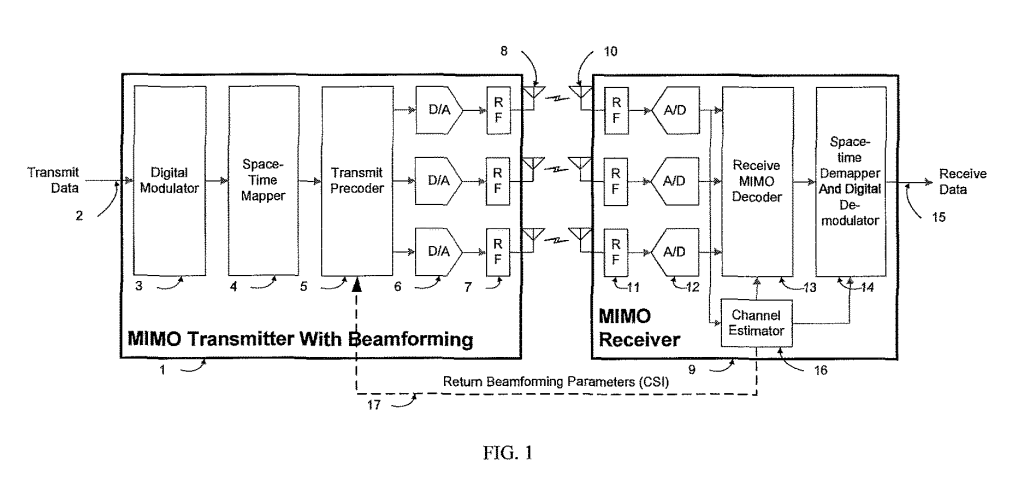
Each figure must be numbered in consecutive Arabic numerals, prefixed with FIG. For example, FIG. 1, FIG. 2, etc. Figure numbering must be independent of sheet numbering and should reflect the order or logical flow of the invention. However, if only one figure is present, it must not be labeled FIG. 1.
Source – Google Patents
New drawing sheets must be labeled in the top margin as either “New Sheet” (for added figures) or “Replacement Sheet” (for updated figures). If replacing a sheet, it is important to include all the original figures from that sheet, even if only one is changed.
You must also submit an “Annotated Sheet” showing the changes, and explain them clearly in the amendment remarks.
Text in U.S. patent drawings is tightly controlled. While some words are allowed, they must follow strict placement and formatting rules to avoid rejection.
Yes, but only when necessary for understanding the invention. Brief legends or short descriptive words may be included if approved by the USPTO or required by the examiner.
Any permitted text or reference characters must follow strict placement rules:
If the text is in a foreign language or script, it must not impair reproduction or create confusion.
USPTO requires drawings to meet strict formatting standards for clarity, reproducibility, and compliance. This section outlines how your lines, lettering, scale, and reference signs must appear.
All lines must be black, durable, clean, uniformly thick, and well-defined. All lines should be durable and heavy enough to permit clear reproduction in print. No colors or grayscale shading is allowed unless approved in rare cases.
Cross-sections must be hatched with evenly spaced, oblique parallel lines. Hatching must not interfere with reference characters or lead lines. If reference signs must appear in hatched areas, it is recommended to leave blank spaces.
Drawings must be scalable and clear enough that when reduced to two-thirds of their size, all elements still remain legible.
You can include a graphical scale bar in your drawing, but text such as “scale ½” or “actual size” is not allowed. The scale must support clarity upon reduction.
They must be plain, legible, and at least 0.32 cm (⅛ inch) in height. Brackets, quotation marks, and outlines like circles are prohibited. Text must run left-to-right, and all identifiers should follow the view’s orientation.
Lines in USPTO drawings must be made using drafting instruments or CAD tools to ensure clarity and reproducibility. Freehand lines are generally not permitted, except in limited shading situations. Even then, they must follow reproduction standards.
All parts of a figure must appear in proportion to one another, unless a different scale is essential for clarity (e.g., enlarged detail views).
Numbers, letters, and reference characters must measure at least 0.32 cm. (1⁄8 inch) in height.
Yes. Several figures can appear on one sheet, as long as they are clearly separated and do not overlap. If a figure spans multiple sheets, they must align seamlessly.
Figures must be arranged without wasting space, preferably in an upright position. All views must be clearly separated from one another and not overlap. If a view is too wide for an upright orientation, it may be rotated so the top is on the right-hand side of the sheet.
Yes. A file reference such as a docket number or application ID may appear in the upper left corner of each sheet, but it must be outside the usable drawing area (i.e., within the top margin only).
No. All reference characters (e.g., item numbers) used in the drawings must also be mentioned in the specification, and vice versa.
Yes. The same part of an invention must always be labeled with the same reference character throughout all drawings and views. Reference numbers must never be reused for different parts.
When there are many reference characters, it is recommended (but not mandatory) to include a separate reference character sheet listing each number and the part it represents. This improves clarity and aids the examiner.
Yes, but only in exceptional cases where a photograph is the only practical medium (e.g., gels, plants, tissue slides, or crystalline structures). Black-and-white photos must meet the same margin and paper standards as drawings. Color photos are allowed only if a petition is filed and granted.
Navigating USPTO patent drawing standards can be tricky but precision here means fewer delays and smoother filings. From figure formatting to line quality and labeling, small missteps can cost big in time and rework.
If you’d like expert help, Pinch can turn your sketches into fully compliant drawings quickly and accurately.
Patent drawings are more than just visuals. They’re part of the legal record. That means precision matters. Margins, line weights, and reference signs all need to follow USPTO standards.
If that sounds like a lot to figure out, your worry ends here. Pinch Patent Drawings takes the guesswork out. Just send in your CAD files or rough sketches, and we’ll return clean, USPTO-compliant drawings ready for filing.
It’s quick. It’s accurate. And your first use is free when you sign up.
Disclaimer: This article is based on official USPTO guidance, including 37 CFR § 1.84, and MPEP § 608.02. Every effort has been made to accurately summarize and simplify the requirements for patent filers. The information reflects the regulations in effect at the time of writing. However, future updates or changes may not be captured here. For the most current requirements, readers are encouraged to consult the latest USPTO rules and manuals directly before preparing or submitting drawings.


